Manual network setup and recovery made multi-tenant operations slow and difficult to validate.
RIT Dubai · Collaborative academic project · Spring 2026
SmartMall AI Network Automation
A proof of concept that turns plain-English requests into explainable network plans, deployment actions, validation evidence, and closed-loop recovery.
All group members contributed equally across the project.
Verified project record
Evidence, scope, and outcome.
All five group members contributed equally across the project.
Collaborative academic proof of concept in an emulated GNS3 environment.
Approved team report visuals, validation records, recovery reports, and an interactive synthetic demo.
The demonstrated correction improved passing pings from 7/10 to 9/10 in about seven minutes.
01 / System overview
From intent to verified change.
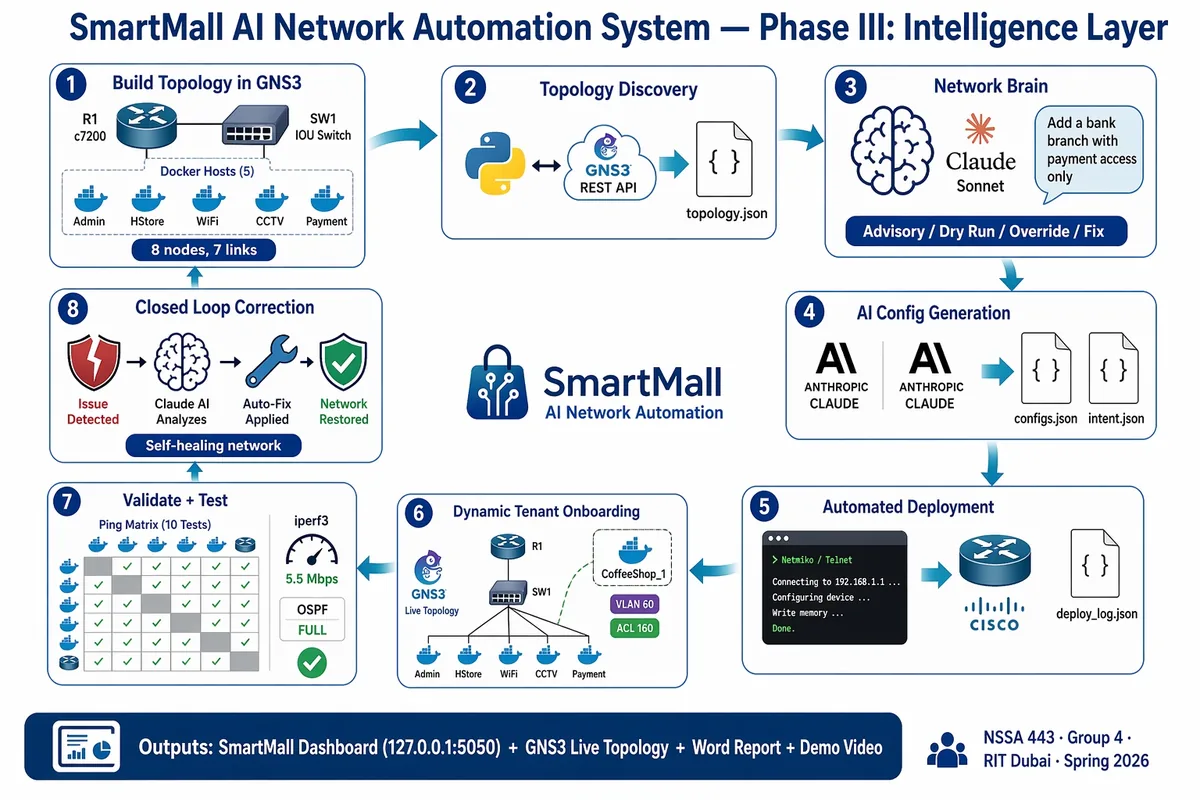
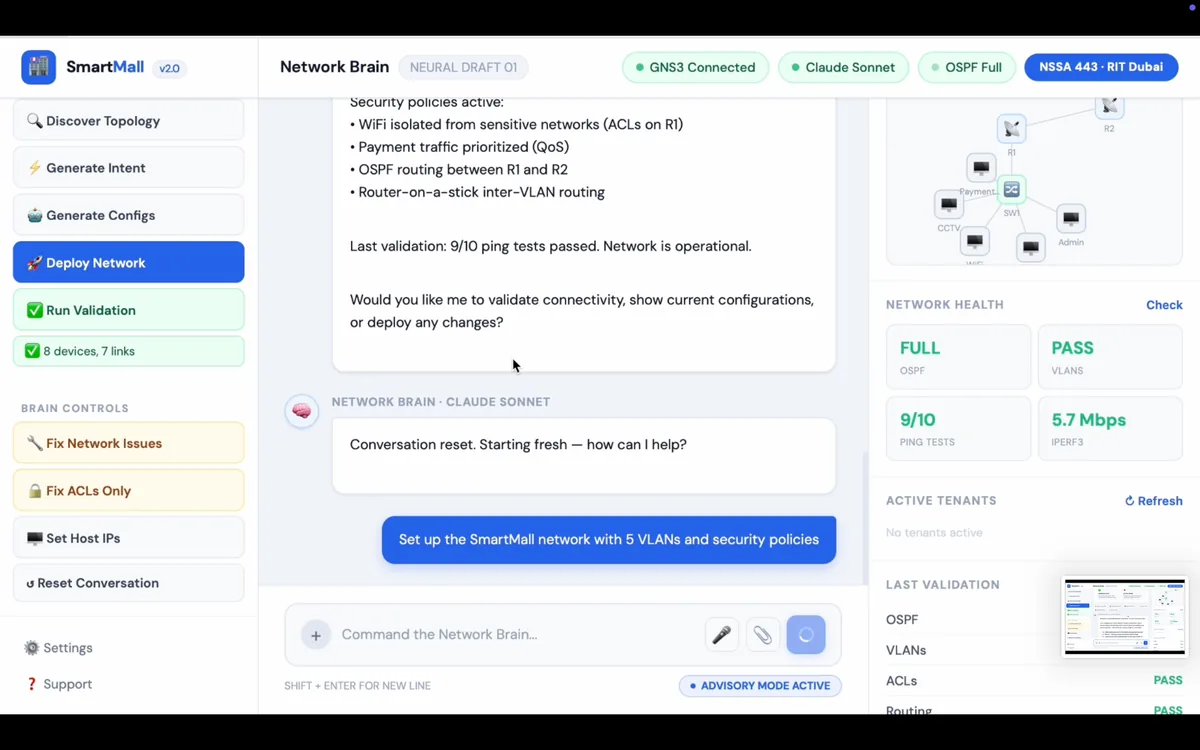
The system combines a browser interface, an AI-assisted intent layer, Python automation, and an emulated Cisco network.
Presentation
HTML, JavaScript, and CSS provide chat, controls, tenant records, live topology, and system feedback.
Intelligence
The Network Brain interprets requests, carries current topology context, and produces structured actions.
Automation
Python, Flask, Netmiko, and GNS3 coordinate configuration, validation, tenant lifecycle, and recovery.
02 / Network design
A segmented smart-mall baseline.
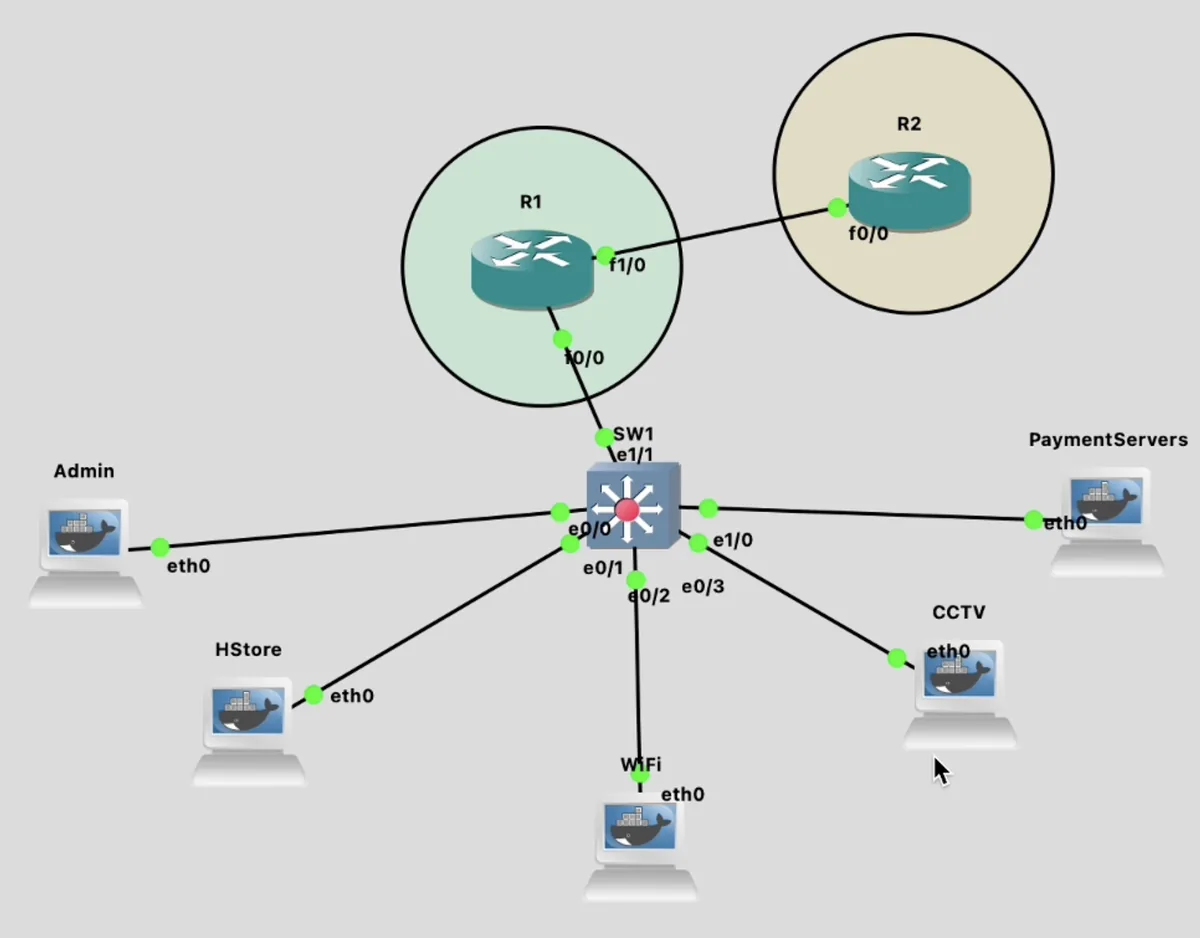
The proof of concept used five trust zones, router-on-a-stick inter-VLAN routing, OSPF, ACL policy, and QoS prioritization.
Policy model
Trust zones with explicit access boundaries.
- Admin, hardware store, Wi-Fi, CCTV, and payment zones
- OSPF Area 0 between the two routers
- Extended ACLs enforcing zone-to-zone policy
- QoS prioritizing payment traffic, then admin and CCTV
- Docker hosts supporting ping, curl, and iperf3 tests
03 / Key workflows
Automation with reviewable evidence.
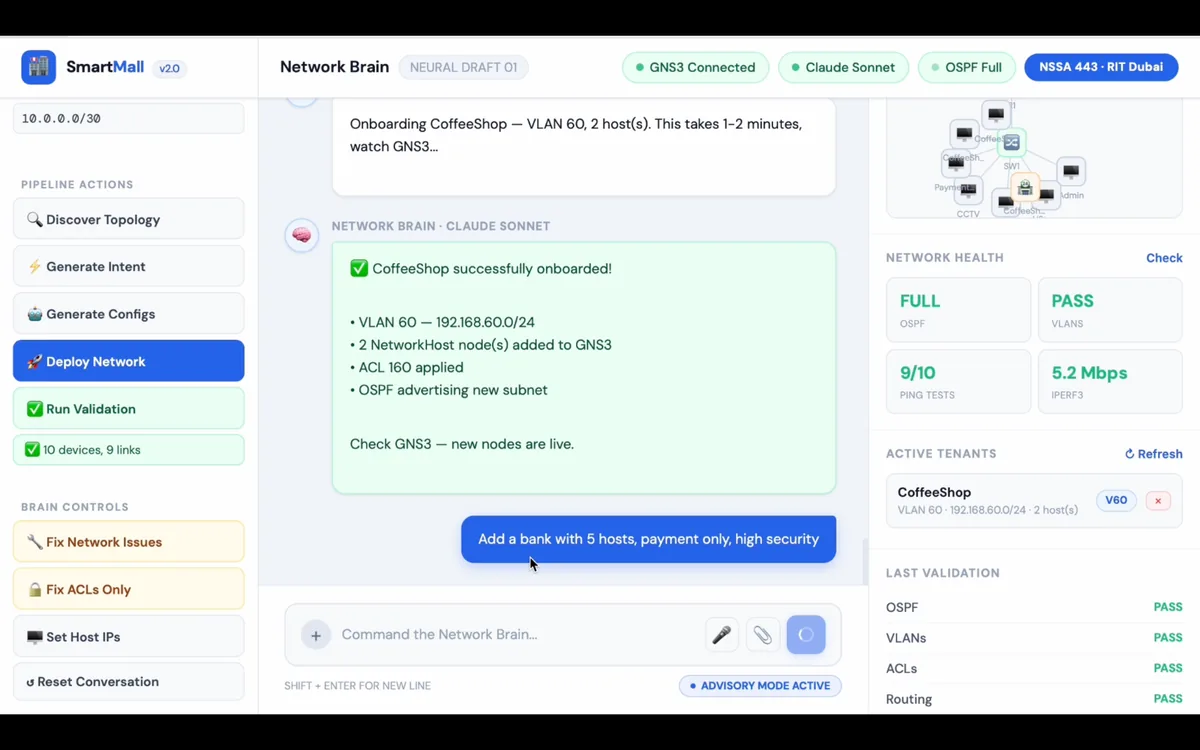
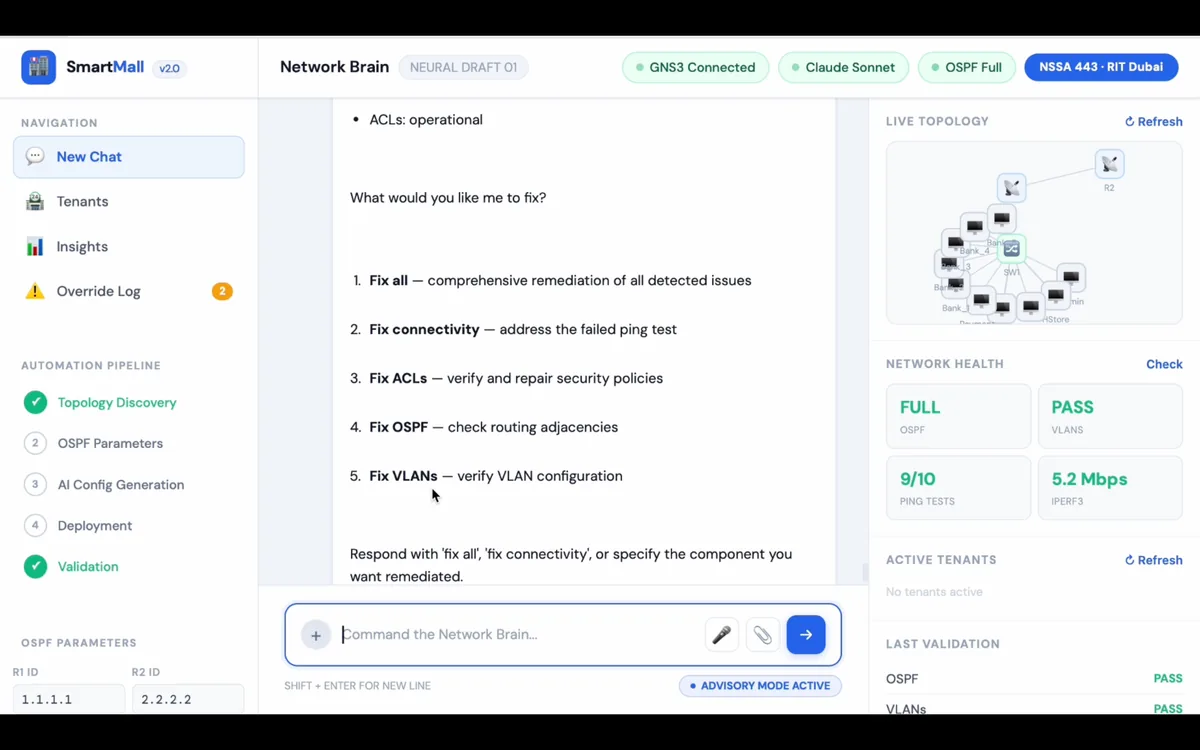
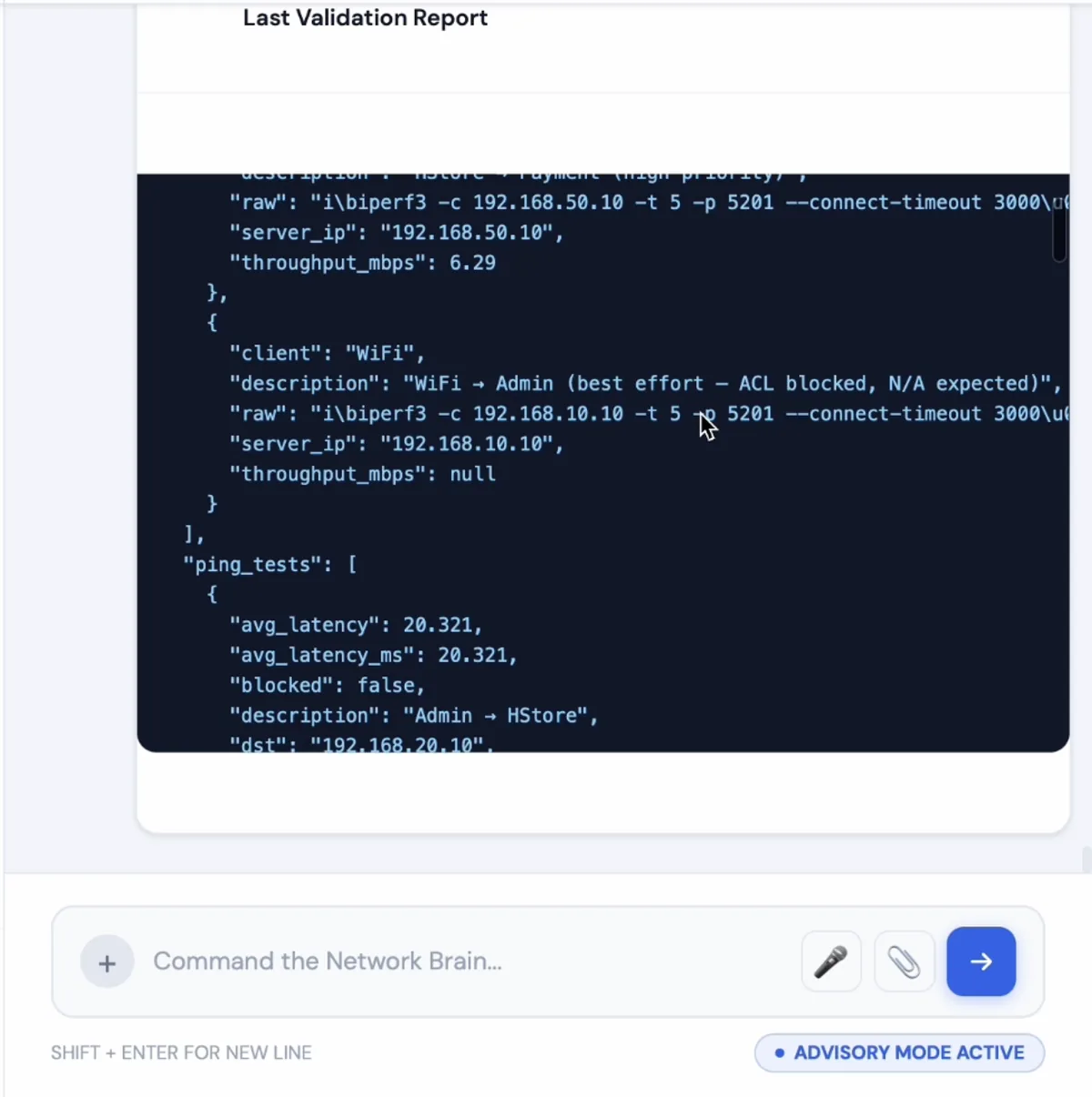
04 / Interactive explainer
Detect. Explain. Recover.
This simplified frontend interaction demonstrates the closed-loop idea without connecting to the original lab.
CORE
ADMIN
PAYMENT
WI-FI
CCTV
Explainer status
Ready for validation
- 00:00.00Illustration initialized.
05 / Validation
Team results, stated with boundaries.
Before correction
7 / 10 pings
Passed after the Wi-Fi isolation ACL was deliberately removed.
After correction
9 / 10 pings
Passed after the closed-loop correction process.
Observed runtime
≈ 7 minutes
Reported for the demonstrated correction sequence.
Project scale
Proof of concept
Small emulated topology, not a commercial production network.
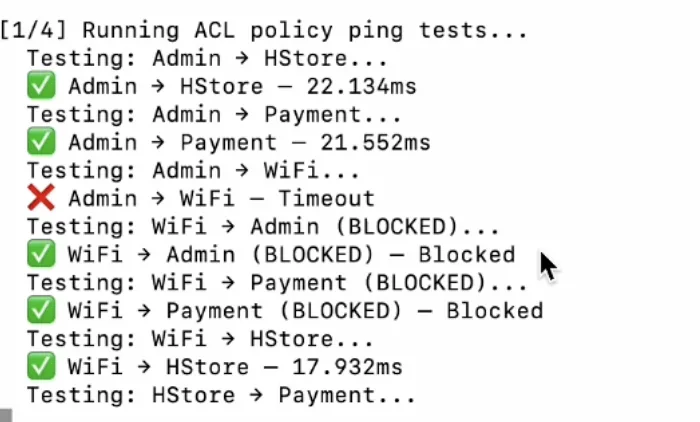
06 / Honest limitations
What the proof of concept did not solve.
Performance
Full validation could take about five minutes, with larger cycles reaching roughly fifteen minutes or more.
Concurrency
Simultaneous onboarding requests were not supported and could conflict over VLAN or port assignments.
Scope
The environment was small, IPv4-only, Cisco-focused, single-site, and lacked production RBAC.
AI reliability and cost
Generated ACLs sometimes differed from policy, and model calls were reported as comparatively expensive for the prototype.